


What Families Need to Know About This Growing College Option
There’s a new wrinkle in the already complex college admissions process: direct admission. Instead of filling out lengthy applications and waiting months for decisions, some students are now being told by colleges, “You’re in”—before they’ve even applied.
Several models are taking shape. College Board BigFuture has launched a program open to a wide pool of students, while the Common App Direct Admission program focuses on first-generation and lower-to middle-income students who may not have strong support systems. In addition, several states have created their own versions aimed at keeping more students on the path to higher education.
How Direct Admission Works
BigFuture Direct Admissions
Students log into their College Board account and opt in. After answering a few questions about GPA, test scores, and coursework, participating colleges decide whether to offer admission with no application required. Sometimes the offer is contingent on additional information, but often it’s that simple.
The main benefit is timing: students can start senior year with solid college options already in hand, often as early as August.
Common App Direct Admissions
When students complete their Common App profile, their information is shared with participating colleges. Those schools then decide whether to extend admission offers directly. Students receive these offers through their Common App account and by email, giving them a chance to explore schools that may not have been on their radar.
Benefits and Trade-Offs
Both approaches dramatically reduce stress. However, the trade-off is that students may be less likely to “stretch” and apply to schools that could be a better academic, social, or personal fit. Direct admission is especially helpful for students with limited guidance navigating the admissions maze.
Statewide Direct Admission Programs
While South Carolina does not currently have a program, neighboring states do:
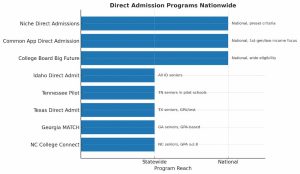
- North Carolina College Connect: Automatic admission for seniors with at least a 2.8 GPA to a wide range of public and private colleges.
- Georgia MATCH (2023): Sends guaranteed admission letters to seniors based on GPA.
- Texas Direct Admission: Students plug in GPA and test scores for instant results.
- Tennessee Pilot (2025): Seniors receive admission letters plus personalized financial aid estimates.
Idaho pioneered the idea in 2015, automatically offering admission to all qualified high school graduates. Since then, more than a dozen states have followed with similar programs.
National Platforms
Beyond state-led efforts, several platforms make direct admission available nationwide:
- College Board BigFuture: Wide eligibility, connecting students to a broad mix of colleges.
- Common App Direct Admission: Focused on first-generation and lower-income students.
- Niche Direct Admissions™: Matches students to schools using predetermined criteria for instant notifications.
These initiatives shift the power to colleges, who rely on existing student data rather than essays, recommendations, or lengthy applications.
Why Direct Admission Matters
Direct admission reduces barriers for students who might otherwise get lost in the process. It offers:
- Confidence at the start of senior year.
- Lower application costs.
- A higher likelihood of pursuing higher education.
For colleges, direct admission broadens access and supports enrollment goals at a time when application numbers and yield rates are unpredictable.
Still, there are limitations. Students admitted this way may not explore as many options as they would through traditional applications. The focus is often on access rather than holistic fit. For some, that’s a worthwhile trade-off; for others, a more intentional college search may still be best.
A National Snapshot
Across the country, direct admission programs vary in scope and audience. Some are statewide guarantees, others are national platforms targeting underserved populations. Together, they represent a shift in how students and families think about access to higher education.
#image_title
How Students Can Use This Option
I encourage students to take advantage of direct admissions programs available to them while still conducting an in-depth college search. Direct admission offers peace of mind; students know they will be going to college and that colleges want them. That assurance can ease the fear of rejection.
Once all results are in, students may discover options they hadn’t previously considered. From there, they can make informed decisions based on cost, quality of life, and academic opportunities.
The Bottom Line
Direct admission isn’t meant to replace the traditional process but to supplement it. For students with strong support systems, the Common App and school-specific applications remain the norm. But for first-generation students, those from lower-income backgrounds, or anyone seeking early assurance, these programs provide a smoother pathway.
As more states adopt the model and national platforms expand, direct admission college programs are becoming a major feature of the admissions landscape, one that may reshape how students and families approach the college journey.